
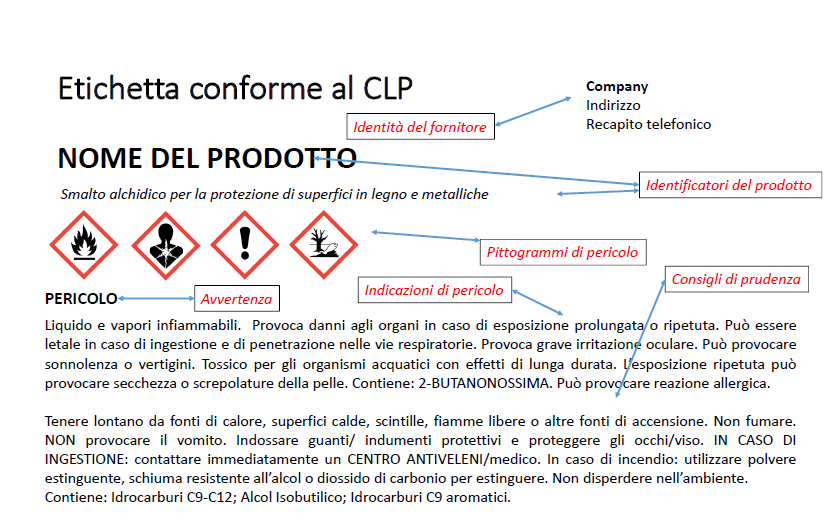
Pursuant to article 17 of the CLP regulation, a substance and a mixture classified as hazardous shall be provided with a label containing the following elements:
- name, address and telephone number of the supplier (s);
- in the nominal quantity of the substance or mixture contained in the package made available by the public, if such amount is not indicated elsewhere in the neck;
- product identifiers;
- if appropriate, the hazard pictograms;
- if applicable, warnings;
- if appropriate, the hazard;
- if applicable, on appropriate precautionary statements;
- if applicable, a section for additional information.
The CLP regulation states that if the substance or mixture is placed on the market, the label should be written in the official language or languages of the member State or member States, except in the case where the member State or member States concerned have agreed otherwise. Suppliers can meet this requirement by producing a single-label multi-lingual in the official languages of the countries in which the substance or mixture shall be provided, or producing labels distinct for each country, each in the appropriate language or languages. At their discretion the supplier can use the label more languages than those required by the regulation, provided that in all languages the same information is given. However, this should not affect the legibility of the information that must appear in the label, nor can it determine exemptions from the labelling requirements set out in article 29 of the CLP regulation.
According to article 17 of the CLP regulation, on the label must be given the contact details of one or more suppliers. In principle, the supply chain can be more than a supplier of the same substance or mixture, for example, if the mixture has been supplied by a formulator to a distributor who in turn could distribute it to third parties. However, article 17 of the CLP does not specify if in such cases it is necessary to bring the contact details of both the providers, nor if the contact details of a particular vendor to take precedence.
In the event that a supplier changes the packing in such a way that the label elements referred to in CLP article 17 should be placed on the label/packaging in a different way compared to how they were in the time in which it was provided, these must add the contact information for your supplier's own and in its own name or to replace them completely, as it is responsible for repackaging and re-labelling of the substance or mixture. In case you do not make changes to the packaging such as to make necessary changes to the labelling, this addition to or replacement of the contact details does not become necessary, but remains optional. If the supplier changes the language or the languages listed on the label, you must add their contact details to those of the supplier, which has the original label, being responsible for the correct translation of the content of the label.
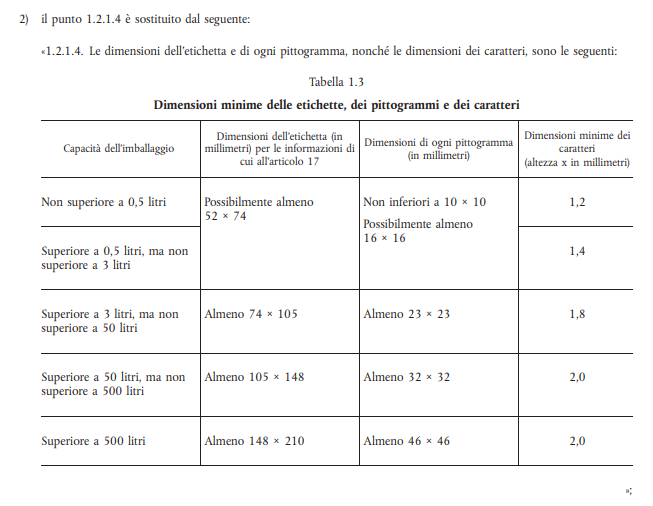
The minimum dimensions of the label:
| # | The ability of the neck | Label size (mm) | The size of the pictogram (mm) |
|---|---|---|---|
| 1 | ≤ 3 L | At least 52 x 74 | Not less than 10 x 10, Preferably at least 16 x 16 |
| 2 | > 3 but ≤ 50L | At least 74 x 106 | At least 23 x 23 |
| 3 | >50 but ≤ 500L | At least 105 x 148 | At least 32 x 32 |
| 4 | >500L | At least 148 x 210 | At least 46 x 46 |
Indications of danger
On the label according to the CLP regulation shall also bear the relevant hazard statements describing the nature and severity of the hazards of the substance or mixture, cf. article 21 of the CLP. Is an example of the indication of danger attributed to acute oral toxicity, category 4: “Harmful if swallowed” (H302).
If the classification of a substance is harmonised and included in annex VI, part 3, of the CLP regulation, on the label must be used for the indication of danger or hazard to match. Note that some of the classifications in annex VI, part 3, CLP are minimum ratings, in which case it may be necessary to assign a classification more serious as well as the indication of danger to it. In addition, in the case of dangers that are not harmonized which are not covered in the list of annex I, it may be necessary to include the signs of danger.
If a substance or mixture is classified in the most hazard classes or differentiations of a hazard class, shall appear on the label all the signs of danger resulting from the classification, except in the case of obvious repetition or redundancy.
Precautionary statements
On the labels under CLP are relevant precautionary statements, which provide guidance on the measures necessary to minimize or prevent adverse effects to human health or the environment arising from the hazards of a substance or mixture.
Exemptions from the requirements of the labelling and packaging.
Not all packaging will allow the disposal, in accordance with the requirements referred to in article 31 of the CLP, all the necessary labeling information on the label or on the packaging itself. The article 29 and annex I, section 1.5.1 of annex I to the CLP regulation recognize such situations and provide for exemptions from the packaging so small or having a shape such that it is impossible to meet the requirements of CLP article 31. While most of these provisions were borrowed from the DSD/DPD (“small packaging, and shape is not suitable”), through the CLP have been introduced to new, out of the necessity of a legal framework to keep pace with technological developments in the field of packaging and to grant the supplier a certain amount of flexibility when you have to deal with packaging for which the labelling presents difficulties.
The packaging of a substance or of a mixture can be so small or have a shape such as to make impossible the provision of the label elements in accordance with the requirements referred to in article 31 of the CLP. This may be due to the fact that it is necessary to include on the label more than one language in the member State on whose market is entered for the substance or mixture, or simply to the fact that the packaging is too small or difficult to label because of its shape, so that the whole series of elements of the label could not be brought even in a single language. In particular, the label may be unreadable horizontally when the package is placed in the normal way or the size and spacing of the elements of the label are insufficient because these are easily readable.
In such situations, the label elements defined in article 17 of the CLP can be provided in one of the following ways:
- on the fold-out labels; or
- on tie-on tags; or
- about outer packaging
If the labelling information in a whole may not be provided through any of the options in the previous section, in particular if:
- the packaging is so small, or you have a form (not suitable) that it is impossible to meet the requirements referred to in article 31 for a label in the languages of the member State on whose market the substance or mixture is placed, and if the labelling information may be provided either in the form of the fold-out label, either in the form of tag pendant, or on an outer packaging, for example, in the case of soluble packaging, or in the case of the filling of a substance or a mixture in bottles of reduced volume (125 ml or less), and subsequently marketed, or when bottles of reduced volume (125 ml or less) are no longer sold in the outer packaging, but individually the article 29, paragraph 2, of the CLP allows the supplier to reduce the information on the label, which would normally be required pursuant to article 17 of the CLP.
Regulation (EU) 2024/2865 – The new on’labelling
The new Regulation (EU) 2024/2865 has introduced interesting news concerning l’labelling of the products.
Until today, in fact, l’fold-out label was permissible only in the case where there is insufficient space on the’packing, but from the first of July, 2026 will always be eligible for use provided with l’indication of all information as required by law.
Another novelty is the possibility of introducing, always from the first of July, 2026, the a’a digital label, in addition to the physical one, as long as the departure’packaging there is a data carrier (for example, a QR Code) and l’indication "for more information on the hazards are available online" (or similar formula) that allows the consumer to access it through the l’and the use of digital devices.
Finally, the labelling will indicate the change of the directions contained in the’part 1 of Annex I of the CLP Regulation, applicable from the first of January 2027, related to the minimum size of the labels, pictograms, and characters. Who will buy chemicals will then verify the new labels not only for their content but also for their form (characters, and the size of the words).
The following point is added:
"1.2.1.5. The text on the label has the following characteristics:
- printed in black on white background;
- the distance between two lines is at least 120% of the font size;
- it only uses one type of font that is easily readable and without thanks;
- the spacing is adequate to allow easy readability on the character type chosen.