LEED®certification
LEED® is a voluntary certification program that can be applied to any type of building (commercial and residential), and concerns the whole life cycle of the building, from design to construction.
LEED promotes a research-oriented approach to sustainability by recognizing performance of buildings in key areas, such as to save energy and water, the reduction of emissions of CO2the improvement of the ecological quality of the interiors, the materials and resources used, the project and the selection of the site. Developed by the U. S. Green Building Council (USGBC), the system is based on the attribution of the “credits” for each requirement. The sum of the credits is the 4 levels of certification: basic, silver, gold, platinum.
GBC ITALIA (Green Building Council of Italy) is the body sponsored by the società consortile Distretto Tecnologico Trentino, which introduced the LEED standards in our country starting from April 2010. The participating agencies in the public, industrial and research world.
LEED certification is going fast establishing itself as the new global standard for the construction of eco-compatible (it is now applied in 40 different countries). Allows you, better than other tools, and to exalt the characteristics of “green” of the buildings, giving them a significant added value. It also allows easy comparison of properties of alternative in the market.
Categories of the LEED rating
The certification of the building, in the latest version of the protocol to the american, is based on a checklist divided into eight categories:
- Transport and location (LT)
- The sustainability of the site (SS)
- Efficiency of water resources (WE)
- Energy and atmosphere (EA)
- Materials and resources (MR)
- Indoor environmental quality (IEQ)
- Innovation (I)
- Regional priority (PR)
The design of the building should meet the majority of requirements for each area. The maximum possible score is 110 points and corresponds to the LEED Platinum certification. The minimum score to obtain certification is 40 points, corresponding to the LEED certification of the base.
Products and contribute to LEED credits
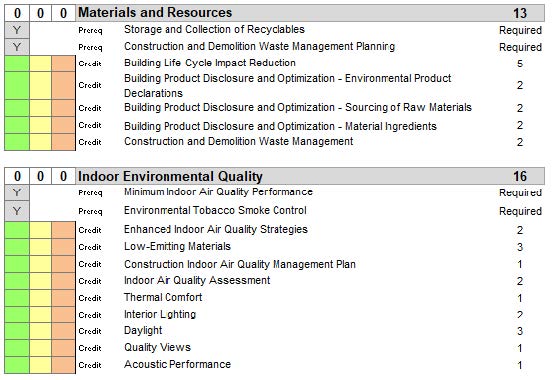
In the check list LEED products can contribute to the score of the building as MR (Materials and Resources) and IEQ (Indoor Environmental Quality), if considered in the special conditions LEED:
- Building Product Disclosure and Optimization: if you have an EPD.
- Building Product Disclosure and Optimization – Sourcing of Raw Materials, Raw Materials: if they contain recycled material.
- Building Product Disclosure and Optimization – Material Ingredientsif they have a statement of the content of 0.01%, in addition to the SDS.
- Low Emitting Materialif they have an emission test CDPH (valid all over the world) or AgBB + French VOC (Europe only).
The thermal materials may also participate in the policy.